
5.0 KiB
| title | source | author | published | created | description | tags | ||
|---|---|---|---|---|---|---|---|---|
| Interstitial journaling: combining notes, to-do and time tracking | https://nesslabs.com/interstitial-journaling |
|
2020-04-15 | 2025-08-09 | Interstitial journaling is a productivity technique created by Tony Stubblebine. To my knowledge, it’s the simplest way to combine note-taking, tasks, and time tracking in one unique workflow. You don’t need any special software, but Roam Research makes it even easier to do thanks to the flexibility of daily notes. Interstitial journaling has had an ... Read More |
|
Interstitial journaling is a productivity technique created by Tony Stubblebine. To my knowledge, it’s the simplest way to combine note-taking, tasks, and time tracking in one unique workflow. You don’t need any special software, but Roam Research makes it even easier to do thanks to the flexibility of daily notes. Interstitial journaling has had an amazing impact on my productivity and creativity, and I think many people would enjoy it.
The basic idea of interstitial journaling is to write a few lines every time you take a break, and to track the exact time you are taking these notes. For instance:
10:04 - Going to finish the first draft of the mindful productivity article.
10:46 - I fell into a Twitter blackhole again! Back to work.
11:45 - Made good progress. Need to get ready for meeting with Charlie.
11:49 - Reviewed agenda and docs. Feeling a bit anxious, but I think it will go fine. Need to call Anna after the meeting to debrief.
Notice the mix of goals (“finish the first draft”), self-awareness (“fell into a Twitter blackhole”, “feeling anxious”), self-review (“good progress”), and actionable items (“call Anna”)?
I love interstitial journaling because it’s a great way to make your breaks more mindful.
- Proactive breaks: reflect on your previous task, plan for the next one, take your own mental pulse, jot down anything else that comes to mind so as to reduce your cognitive load.
- Procrastination breaks: become aware of these breaks and how long they actually take. When you create the habit of writing down all your breaks, it becomes easier to not open a new tab to “quickly” check Twitter. You don’t want to have to admit that failure to yourself.
Your interstitial journal is not only a journal, it’s a to-do list, a note-taking system, and a way to track your time meaningfully. As I mentioned, you can keep an interstitial journal anywhere. Even a text file would work well.
If you’re a Roam Research user, let’s see how you can easily set it up there. I’m saying “setting it up”, but really… The work has been done for you already.
Keeping an interstitial journal in Roam Research
In my beginner’s guide to Roam, I completely left out the Daily Notes section to keep things simple. Let’s now have a look together. This is what a daily note with interstitial journaling looks like.
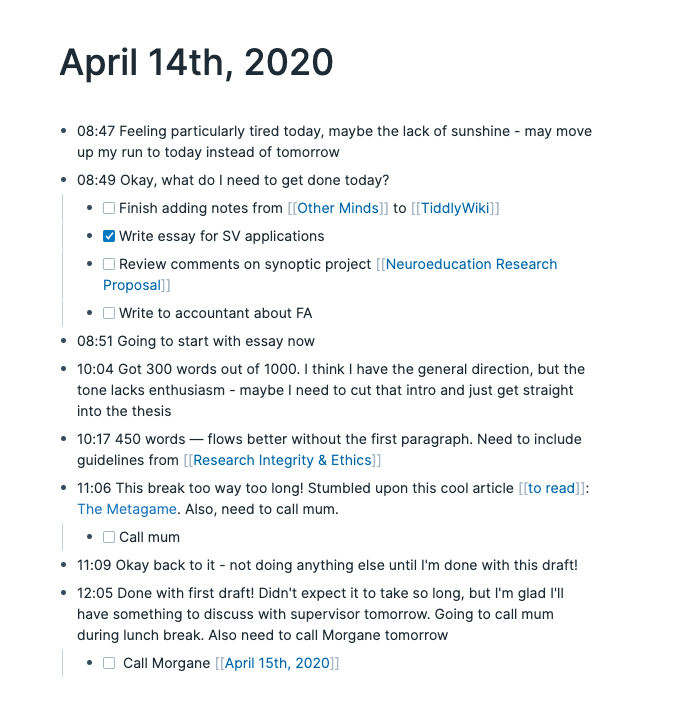
- Track time. Type /time to insert the current time, then type whatever you are thinking about.
- Track tasks. Type /todo to create to-do items. Check off these to-do items when done.
- Track content. When you stumble upon something interesting that would disturb your workflow, add it to master lists such as To read. You can see I have done it in this screenshot with an interesting-looking article that had nothing to do with the essay I was trying to write.
- Track ideas. Similarly, if you think of something else you’d like to do today, just add it as a to-do where and when you think about it. For people using the Today, Tomorrow, Someday system, you can also add that to the to-do items, or add a specific date, as I have done with “call Morgane.”
- Track well-being. I like to start my work day with a quick note checking in on how I feel, anything that’s been sometimes literally keeping me up at night, any major roadblock I’m anticipating for the day. It’s rarely longer than one bullet point, but it’s a great way to take care of my general well-being. I also finish the work day with a similar quick closing note.
I genuinely feel silly writing out these instructions. It’s an incredibly simple system to make your journal more actionable—or to actually start a journaling practice. As always, it may not be for everyone, but it’s done wonders for me. I still use Plus Minus Next journaling for my weekly review, and interstitial journaling makes it even easier to go back to see what went well and what didn’t during your week.
Join 100,000 mindful makers!
Ness Labs is a weekly newsletter with science-based insights on creativity, mindful productivity, better thinking and lifelong learning.
One email a week, no spam, ever. See our Privacy policy.